FCTA
Fairfax County Taxpayers Alliance Watchdog of the Taxpayer's Dollar Since 1956
The Problem

Taxes Rising 3× Faster Than Your Household Income

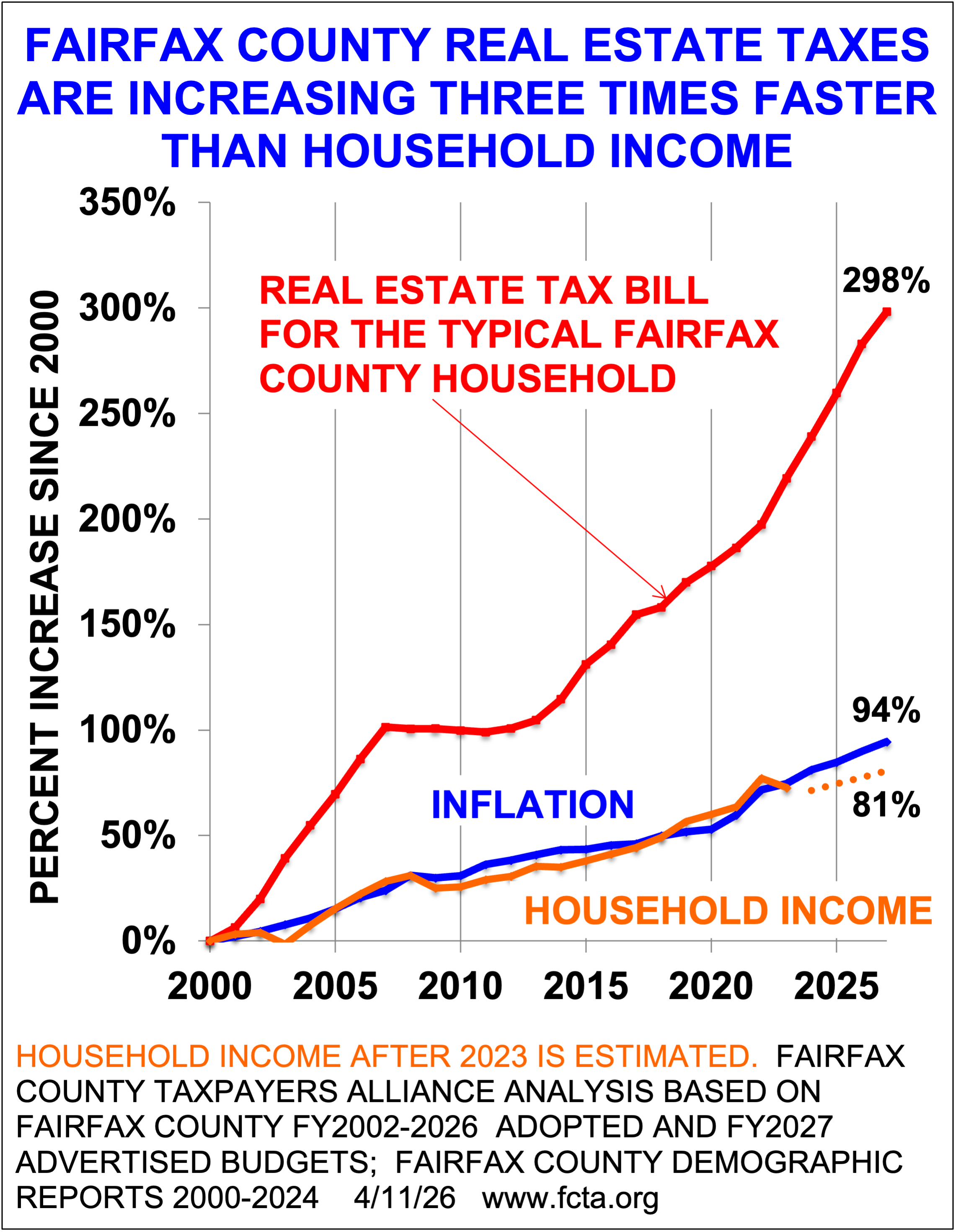
Since 2000, Fairfax County real estate taxes have increased three times faster than inflation and nearly four times faster than household income. The average annual tax bill has gone from $2,123 to $10,031.

Fairfax County real estate taxes increasing 3× faster than household income since 2000
The math is stark: A household earning $100,000 in 2000 earned roughly $178,000 by 2025. But their real estate tax bill nearly quadrupled — from around $2,100 to over $10,000. That is $7,900 more every year extracted from the same household. See the full 50-year chart ›

Why This Rate of Growth Is Unsustainable

When taxes grow faster than income, households have less money for food, healthcare, education, retirement, and everything else. The gap compounds every year. A family that paid $2,100 in real estate taxes in 2000 now pays $10,031 — an additional $7,900 per year that must come from somewhere.

For fixed-income residents and retirees, this is not a small number. For younger families trying to afford homeownership, it makes an already difficult market even harder. The result is what FCTA has documented for decades: residents leaving Fairfax County for lower-tax jurisdictions.

The county claims to be "data-driven." The data here are unambiguous — taxes are rising at a rate that is disconnected from the ability of residents to pay them.

The FY2027 Proposal: Residential assessments rose 4% this year. Under Virginia law, supervisors can lower the tax rate to keep bills flat. Instead, they are proposing to keep the rate at $1.1225 — which means every homeowner automatically pays 4% more. FCTA demands the rate be set at $1.08 to hold taxes flat.
Business Tax Burden
Full Tax Archive ›

Fairfax Businesses Pay 18 Separate Taxes

While homeowners absorb one escalating tax bill, Fairfax County businesses face a stack of 18 separate levies — from the standard real estate and sales taxes to BPOL, stormwater, RGGI (Regional Greenhouse Gas Initiative), utility taxes, and the 4% meals tax.

The cumulative burden is among the highest in Northern Virginia. When the economics no longer work, businesses leave — taking jobs, employees, and commercial tax revenue with them. The commercial tax base has been declining relative to residential, putting even more pressure on homeowners.

This isn't a tax problem only for corporations. When businesses pay more, they hire fewer people, pay lower wages, and charge higher prices. The 18-tax burden ultimately flows to every Fairfax County resident.

The 18 Taxes Fairfax Businesses Pay
1Real Estate Tax
2Commercial & Industrial Tax
3Stormwater Tax
4BPOL Tax
51% County Sales & Use Tax
60.70% Regional Transportation Tax
71.375% Schools Sales Tax
82.925% State Sales & Use Tax
9Social Security
10Medicare
11Workers' Compensation
12Unemployment Insurance
13Business Personal Property Tax
14Communications Sales & Use Tax
15Virginia Electric Utility Tax
16County Electric Utility Tax
174% Meals Tax
18Regional Greenhouse Gas Initiative
← Back
Home

All four issues at a glance.

Go Home
Next
Why Are Taxes Rising?

96% pays raises & benefits, not services.

Read More
Skip To
What We're Getting

SAT scores down, buildings closed.

Read More
Solution
What Supervisors Must Do

Cut rate to $1.08. Freeze salaries.

Read More
Act Now
Email the Supervisors

Demand the $1.08 rate before the vote.

Email Now